
Myths about head lice
Debunking Head Lice Myths
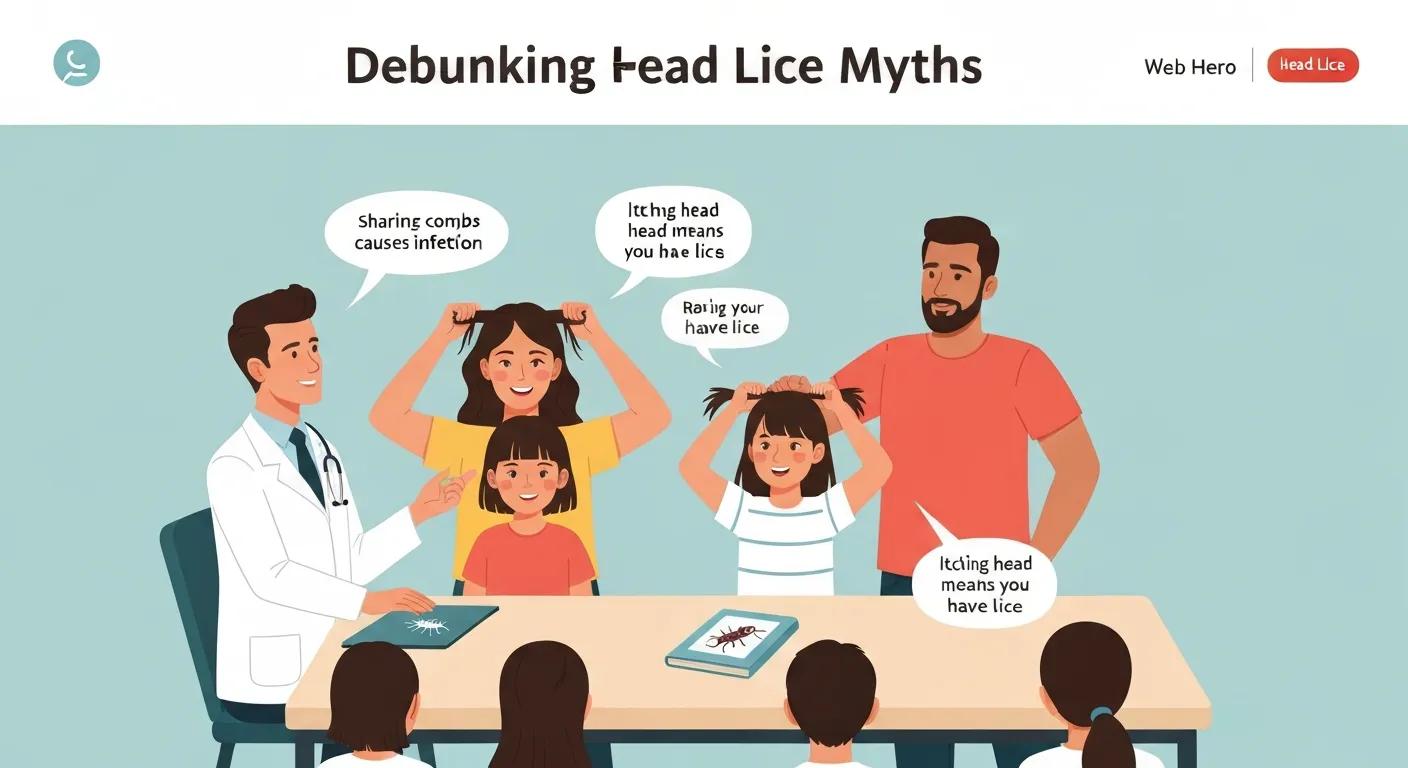
Head lice (Pediculus humanus capitis) are a common scalp parasite that feed on human blood and live close to the skin; this guide separates common myths from evidence-based facts and explains how lice spread, survive, and are best treated. Readers will learn which beliefs are misconceptions—such as lice preferring dirty hair or being able to jump—and which behaviors actually influence transmission risk, detection, and treatment choice. Many families face anxiety and stigma when lice are found, so this article also offers practical prevention steps, clear diagnostic cues, and guidance on chemical versus non-chemical treatments. We examine survival of lice off the host, whether head lice transmit disease, how "super lice" form and resist treatments, and how to recognize other causes of an itchy scalp. Each section uses recent research-based perspectives and authoritative public-health reasoning to provide actionable tips and checklists you can use at home or when deciding whether to escalate care. By the end you'll have a reliable, step-by-step mental model for prevention, detection, and safe treatment of head lice without unnecessary household panic.
Do Head Lice Prefer Clean or Dirty Hair? Separating Hygiene Myths from Facts
Head lice do not prefer clean or dirty hair; instead, they seek warmth, frequent blood meals, and close proximity to a human scalp. The biology of Pediculus humanus capitis means they rely on direct or near-direct contact to transfer between hosts, and hair cleanliness does not provide an attractant or deterrent. Understanding this distinction reduces stigma and helps families focus on realistic prevention: limiting head-to-head contact, checking children regularly, and avoiding shared headgear. The next subsections explain why hair cleanliness is irrelevant biologically and which personal-hygiene behaviors do affect transmission risk.
Why Clean Hair Does Not Attract Head Lice
Head lice locate hosts by crawling and detecting heat and body odor cues; they do not "choose" based on cleanliness or shampoo frequency. Lice lack wings and jumping limbs, so their movement depends on physical contact between heads rather than environmental scent gradients tied to unwashed hair. Scientific observations and public-health guidance show infestations occur equally across socioeconomic and hygiene backgrounds, which emphasizes that infestation is not a sign of poor hygiene. Recognizing this biology helps reduce shame and encourages pragmatic responses focused on detection and removal rather than social judgment.
How Personal Hygiene Affects Lice Infestation Risk
While cleanliness does not attract lice, certain personal behaviors change transmission risk and are worth addressing in prevention plans. Limiting direct head-to-head contact during play or sports, avoiding sharing combs, hats, helmets, and hair accessories, and routinely checking hair after sleepovers or group activities are effective strategies to reduce spread. Parents and caregivers should teach children not to pile clothing or bedding in shared spaces and to store personal hair items separately; these behaviors lower the chance of accidental transfer. Emphasizing these actions over hygiene-based blame supports constructive, stigma-free management and encourages timely detection, which is key to limiting outbreaks.
Can Head Lice Jump or Fly? Understanding How Lice Actually Spread
Head lice cannot jump or fly; they move by crawling using clawed legs adapted to grasp hair shafts. This anatomical limitation makes direct or very close indirect contact the primary transmission routes, and understanding locomotion clarifies why certain interactions are higher risk than others. By focusing on how lice crawl between hair strands, families can prioritize interventions that interrupt close contact pathways. The following subsections explain lice movement mechanics and list the most common real-world transmission scenarios to help readers recognize and reduce exposure.
How Head Lice Move: Crawling vs. Jumping or Flying
Lice possess six legs with specialized claws for gripping individual hair fibers, which enables steady crawling but prevents jumping or flying. Compared to fleas, which have powerful hind legs for jumping, lice are structurally unable to make aerial or long-distance leaps, so myths about jumping or airborne spread misrepresent their biology. Lice movement is therefore limited to the length of hair and the reach created by people touching or leaning heads together. Knowing this makes it easier to explain why classroom outbreaks often stem from close play and not ephemeral airborne exposure.
Common Ways Head Lice Are Transmitted Between People
Transmission generally requires direct or near-direct contact that allows lice to crawl from one scalp to another; indirect transfer via shared items is possible but less common. High-risk scenarios include prolonged head-to-head contact during play, sleepovers, sports like wrestling, and close group photos. Sharing brushes, hair ties, hats, helmets, or unwashed bedding can provide limited opportunities for transfer, especially if items are used within 24–48 hours of contamination. Practical prevention tips reduce risk without causing alarm:
- Avoid direct head-to-head contact during play and while taking group photos.
- Do not share combs, hairbrushes, hats, headbands, or helmets between children.
- Inspect hair after sleepovers, camp, or contact sports to catch infestations early.
- Wash or isolate high-contact items used recently by an infested person.
Research indicates that the primary mode of transmission for head lice is direct head-to-head contact, with indirect transmission via objects being of minimal relevance.
Head Lice: Transmission, Diagnosis, and Treatment in an Era of Resistance
The main route of transmission is direct head-to-head contact; transmission via inanimate objects is of no relevance. Symptoms arise 4–6 weeks after an initial infestation; many affected persons have no symptoms at all. Wet combing is the most sensitive method of establishing the diagnosis and monitoring treatment. Resistance to neurotoxic pediculocidal drugs is increasing around the world. Dimethicones are the treatment of choice, with 97% efficacy.
Head lice: Epidemiology, biology, diagnosis, and treatment, 2016
Do Head Lice Carry Diseases? Debunking Health Risk Myths
Head lice are primarily a nuisance parasite and are not generally associated with transmitting human diseases; the public-health risk from head lice differs markedly from that posed by body lice. Biological and epidemiological evidence indicates head lice maintain close contact with the scalp and feed frequently, but they lack proven capacity to carry and transmit pathogens to humans under normal conditions. This section provides a concise comparison and an evidence-based table showing key contrasts between head and body lice, clarifying why head lice are treated as a social and clinical nuisance rather than a vector-borne disease threat.
The following table summarizes disease transmission differences between head lice and body lice to clarify public-health implications before we explore mechanisms and comparisons.
| Louse Type | Typical Habitat | Disease Transmission Evidence |
|---|---|---|
| Head lice (Pediculus humanus capitis) | Scalp and hair | No consistent evidence of transmitting human pathogens in typical settings; primarily causes irritation and secondary infection risk from scratching |
| Body lice (Pediculus humanus corporis) | Clothing seams, bodies | Documented associations with bacterial diseases such as trench fever and epidemic typhus in conditions of crowding and poor hygiene |
| Pubic lice (Pthirus pubis) | Pubic/axillary hair | Not known to transmit systemic diseases; local irritation and secondary infection possible |
Why Head Lice Generally Do Not Transmit Diseases
Mechanistically, head lice feed and remain localized on the scalp, which limits contact with mechanisms that typically enable pathogen transmission, such as prolonged bacteremia or cross-contamination from clothing. Epidemiological surveys and public-health reviews have not demonstrated consistent transmission of major human pathogens by head lice in developed settings. While heavy infestations and repeated scratching can lead to secondary bacterial skin infections, these are local complications rather than evidence of systemic pathogen spread. Recognizing this reduces unnecessary medical alarm and helps focus responses on removal and skin care when needed.
Comparing Head Lice and Body Lice: Disease Transmission Differences
Body lice inhabit clothing and thrive in overcrowded or unhygienic settings; this behavior creates opportunities for pathogen acquisition and transmission that head lice lack. The environment and behavior of body lice—frequent contact with clothing fibers and movement between hosts via garments—explain historical links to epidemic infections in populations lacking access to laundering and adequate shelter. By contrast, head lice remain on the scalp and hair, making them poor vectors for the types of bacteria associated with body lice outbreaks. Understanding these ecological and behavioral differences informs appropriate public-health priorities and household responses to infestations.
How Long Can Head Lice Live Off the Scalp? Facts about Survival in the Environment
Adult head lice generally survive only briefly off a human host because they require regular blood meals and warmth; typical indoor conditions limit their survival to around 24–48 hours. Nits (eggs) attached to hair shafts depend on scalp warmth to develop and are unlikely to hatch after detaching and lying in the environment for long periods. Environmental factors like temperature, humidity, and access to a blood meal strongly affect survival times, and practical cleaning guidance focuses on high-contact items rather than broad household panic. The subsections below present numeric survival estimates and a practical checklist for household cleaning to clarify what actions are necessary and which are unnecessary.
Before reviewing cleaning steps, this table compares typical survival estimates for adult lice and nits under common indoor conditions to guide household decisions.
| Life Stage | Survival off Scalp | Typical Conditions / Notes |
|---|---|---|
| Adult louse | ~24–48 hours | Dies faster without access to blood; cooler, drier indoor air shortens survival |
| Nymph (young louse) | <24–48 hours | Needs to reach scalp quickly to survive and develop |
| Nit (egg) attached to hair | Up to hatching if on scalp; rarely hatch off-host | Detached nits generally do not hatch; require scalp warmth and humidity to develop |
Typical Lifespan of Head Lice Away from the Human Host
Adult lice typically die within one to two days without a blood meal and scalp warmth, while immature stages have similar or shorter off-host survival times. Detached nits need sustained warmth and humidity from a scalp to hatch; once removed or detached, their viability drops considerably, reducing the chance of infestation from found hairs. These survival constraints mean that treating the person and isolating recently used items is generally sufficient, rather than deep-cleaning the entire home. Understanding these timelines helps prioritize targeted laundry and temporary isolation rather than costly or stressful household-wide measures.
Do You Need to Clean Your House to Prevent Lice?
Practical cleaning focuses on items with close head contact in the previous 48 hours: wash recently used bedding, hats, scarves, and clothing on hot cycle and dry on high heat when possible. Vacuum upholstered furniture and carpets where hair or head contact was recent, and seal non-washable items in a plastic bag for 48 hours to ensure any live lice perish. Deep household cleaning, fumigation, or spraying insecticides is unnecessary and discouraged; these actions do not improve outcomes and can pose health risks. A short checklist for household actions reduces unnecessary work and concentrates effort where it matters:
- Launder bedding and clothing used in last 48 hours on hot settings.
- Vacuum floors and furniture in areas of close contact.
- Seal non-washable items in a plastic bag for 48 hours before reuse.
The survival of head lice off the scalp is limited, typically to 24-48 hours, which informs practical cleaning recommendations.
Head Lice: Transmission, Diagnosis, and Treatment in an Era of Resistance
The main route of transmission is direct head-to-head contact; transmission via inanimate objects is of no relevance. Symptoms arise 4–6 weeks after an initial infestation; many affected persons have no symptoms at all. Wet combing is the most sensitive method of establishing the diagnosis and monitoring treatment. Resistance to neurotoxic pediculocidal drugs is increasing around the world. Dimethicones are the treatment of choice, with 97% efficacy.
Head lice: Epidemiology, biology, diagnosis, and treatment, 2016
What Are Super Lice? Understanding Resistance and Effective Treatment Options
"Super lice" refers to head lice populations that carry genetic changes reducing sensitivity to common over-the-counter insecticides, causing treatment failures with standard permethrin or pyrethrin products. Resistance emerges through selection pressure when the same chemical classes are used repeatedly, allowing resistant individuals to survive and reproduce. Understanding resistance mechanisms and current treatment categories—OTC chemical, prescription chemical, manual removal, and professional services—helps families choose an effective, safe approach and know when to escalate care. The next subsections explain resistance mechanisms and outline alternative and non-chemical treatments, followed by guidance on when to consult a professional.
The following table compares treatment categories, typical efficacy notes, and considerations to help select an appropriate approach in 2025.
| Treatment Category | Typical Efficacy / Notes | Key Considerations |
|---|---|---|
| OTC permethrin/pyrethrins | Variable; reduced efficacy where resistance present | Affordable and accessible but may fail in resistant populations |
| Prescription topical agents | Higher efficacy when matched to resistance profile | Requires clinical assessment; alternatives include malathion or benzyl alcohol in some regions |
| Manual removal (wet-combing) | Effective when done thoroughly and repeatedly | Labor-intensive but avoids chemical exposure and works against resistant lice |
| Professional lice-removal services | High efficacy with combined methods | Useful when home methods fail; services may offer intensive combing and guidance without naming providers |
How Super Lice Resist Common Chemical Treatments
Resistance arises through genetic mutations that alter lice nervous-system targets or increase detoxification enzymes, lowering susceptibility to insecticides like permethrin and pyrethrins. Repeated use of a single chemical class selects for these resistant genotypes, and regional surveillance has reported variable resistance rates in recent years. Treatment failure with OTC products does not mean all options are exhausted; switching to a different treatment category, using a properly applied prescription product, or adopting meticulous mechanical removal can resolve infestations. Awareness of resistance mechanisms encourages alternating strategies and careful follow-up rather than repeated identical treatments that perpetuate selection pressure.
Genetic mutations, particularly those affecting the nervous system and detoxification enzymes, are the primary mechanisms by which head lice develop resistance to common chemical treatments.
Global Trends in Head Lice Resistance Mechanisms and Genetic Markers
Head lice resistance is reported in all continents. The most studied mechanism of resistance is through Knockdown resistance (kdr) mutations, with biomarkers M815I, T917I, and L920F, most commonly reported. Other reported mechanisms such as cytochrome P450 enzyme inhibition, altered acetylcholinesterase binding, and GluCl mutations are still being investigated. Allele mutations linked to pyrethroid resistance differ between regions and countries, which highlights the need for monitoring resistance through region-specific genetic markers. In geographic areas where resistance is well-established, louse populations are predominantly homozygous. In regions where heterozygosity still prevails, selective pressure through the use of chemical pediculicides will cause resistance to increase.
Global Trends in Genetic Markers of Pediculus humanus capitis Resistance Mechanisms, A Sanchez, 2020
Alternative and Non-Chemical Treatments for Super Lice
Non-chemical methods include manual nit removal with a fine-tooth comb (wet-combing), mechanical devices designed to physically remove lice, and heat-based devices in controlled settings; each has trade-offs in time, cost, and evidence strength. Wet-combing performed every 3–4 days for several weeks, using conditioner and a systematic approach, reliably removes lice and nits when done correctly. Professional lice-removal clinics offer intensive combing and expert protocols and can be considered when home efforts repeatedly fail, keeping in mind that services vary and should be evaluated for safety and method transparency. Weigh pros and cons with this short list:
- Manual wet-combing for persistent or resistant infestations.
- Prescribed topical agents when resistance testing or guidance indicates.
- Professional lice-removal services when multiple household attempts fail.
When to consult a professional often depends on repeated treatment failure, widespread household infestation, or if caregivers prefer expert-managed removal; consulting a clinician can clarify prescription options and next steps without endorsing specific companies.
The growing issue of insecticide resistance has rendered some traditional treatments obsolete, necessitating a re-evaluation of treatment strategies and the implementation of clear guidelines that account for regional resistance patterns.
Managing Head Lice Amidst Growing Insecticide Resistance
There is now strong evidence of insecticide resistance established in many countries to such an extent that some of these chemicals have become obsolete. Resistance to some pediculicides can vary from country to country and region to region within a country. The lack of a local monitoring system of resistance patterns means that parents and pupils are hampered in making an informed decision regarding how to treat head lice. One should no longer assume that treatment failure is due to poor treatment compliance or re-infestation. Clear treatment guidelines drawn up by healthcare professionals with an interest in head lice and taking into account regional/national resistance patterns should be implemented.
Managing head lice in an era of increasing resistance to insecticides, 2004
Is an Itchy Scalp Always a Sign of Head Lice? Identifying Symptoms and Other Causes
An itchy scalp can result from head lice but also from many non-lice conditions; visual inspection and wet-combing are the most reliable ways to confirm infestation. Lice bites produce an immune reaction to saliva that causes itching, but this response varies between individuals and can be delayed for days to weeks after initial exposure. Other causes such as dandruff, seborrheic dermatitis, eczema, or fungal scalp infections present differently on inspection and rarely show firmly attached nits near the scalp. The subsections below explain why itching occurs with lice and list common alternative diagnoses with distinguishing signs and basic steps for when to seek clinical evaluation.
Why Itching Occurs with Head Lice Infestation
Itching results from a localized allergic reaction to lice saliva introduced during repeated feeding; the immune response produces pruritus and sometimes visible papules on the neck or behind the ears. Importantly, itching is variable—some people remain asymptomatic for weeks despite active infestation—so absence of itching does not rule out lice. Visual detection of live lice or firmly attached nits within 1–2 cm of the scalp is the diagnostic gold standard. Understanding this physiology supports a methodical detection approach that relies on combing and inspection rather than symptom reports alone.
Other Common Causes of an Itchy Scalp Besides Lice
Several dermatologic conditions mimic lice-related itching and should be considered during assessment; distinguishing features include scale, plaque, or diffuse flaking versus discrete, firmly attached nits. Dandruff and seborrheic dermatitis produce loose flakes and oily scaling, psoriasis creates well-demarcated plaques, contact dermatitis causes irritation linked to products, and tinea capitis (fungal infection) often causes hair loss and broken hairs. When visual inspection and combing are inconclusive or symptoms persist, seek evaluation from a clinician to confirm diagnosis and receive targeted treatment rather than repeated anti-lice measures.
- Key detection step: Use a fine-tooth nit comb on wet, conditioned hair and inspect the comb and scalp systematically.
- When to see a clinician: If combing reveals uncertainty, if multiple household members are infested, or if treatments repeatedly fail.
- When to suspect another cause: Presence of widespread flaking, hair loss, or scaly plaques suggests non-lice dermatologic conditions.
These steps streamline diagnosis, reduce unnecessary treatments, and guide appropriate clinical follow-up when needed.

Facebook
LinkedIn
Instagram
TikTok